Tuesday, October 29, 2013

processing change


Ten days after arriving home from Farrera, the results of my artist residency are as unsubstantial as my project proposal was. Yet I would term the experience an unqualified success. It is as hard to describe the outcome as it was to describe the original idea that I wanted to pursue. Yet after four or five studio sessions here at home, it is clear that I am painting from a different place than I was before the challenges and discipline of the residency.

I am more relaxed, less hurried, more involved in the process and in small refinements. I have a sense of more resources at my disposal, and a greater awareness of the variety of techniques available to me. I am glad to get back to cold wax and oil, but am also glad to know about the possibilities of acrylics.

I have reacquainted myself with my studio and my materials by finishing up some old pieces such as that above (8" x 8"), and have put initial layers down on two large fresh panels without any specific plans or ideas. I just want to get my hands wet, as it were. I have a sense of waiting for something, whether inspiration or energy, I am not sure. I can't just pick up where I was before the residency, because something has changed. But I am not clear about what it is, and it feels right to just take some time off and let whatever it is come into sight.

Wednesday, October 16, 2013

coming to a close

My last day in Farrera. I have been painting spontaneously these last few days, using up materials and just letting process flow. The last trio of pieces is unfinished (the one at left, 16"x 20", is definitely a localized palette), but I am pleasantly happy with where they are going. I asked Phyllis, to whom I sent photos, if she thought they looked like "my" work, and she said yes. And when Lluis came to choose the piece to be donated to the Center, he also chose from this final trio. Both of these responses seem to validate my own satisfaction with them.

Phyllis asked me if I feel that the pieces look like my own. I'm not sure. Certainly they have characteristics similar to to other work I've done, yet they are the result of a looser and more casual process than I usually undertake. Part of what I like about them is their very looseness and informality. On the other hand, these are certainly not definitive pieces, and are almost throwaways. Indeed, I probably won't finish them, but will take them home, as reminders of what I've done here.

So after literally weeks of pushing my own limits, and of questioning nearly everything I do in the studio, it is hard to come to any conclusions. I have recognized that my orientation is toward abstract landforms rather than close-up details, or surfaces, or actual landscapes. I like to have structure and shape in my paintings, but these are referential rather than representational. I have gained strength from my experiments and from the persistence of showing up every day and keeping going. I think that the conclusions, if any, will come later, after I have returned to my own studio and my own environment, and can explore where this experience leads me.

Thursday, October 10, 2013

mid-residency report

Most of my time here in Farrera has been spent exploring the moods and emotions that I bring to painting, and that painting invokes in me. I spent the first week of my residency trying hard to paint from a place of emotion, and just got frustrated. I don't paint emotionally, but rather from responses and impressions to what is around or in front of me. Music contacts my emotions; visual art fills a different role and expresses a different side of me. The image at left is one of the works, 16" x 20", that resulted from that first week of work.

My second experiment, inspired by my recent contact with Diebenkorn's work, was to paint from representational compositions, approaching them abstractly and trying to express an emotional response to the original scene. The emotional aspect again did not work, and after struggling for a few days, I also realized that I was dividing my process into two parts, starting a piece figuratively and then abruptly switching to abstraction. The transition occurred when I got frustrated or bored with the restrictions or misdirections of the figuration. At that point, however, I would resort to compositional knowledge, seldom referring to the initial scene, and working randomly rather than following a plan. Working from representation doesn't seem to work for me, just as planning the process in advance does not work.

My overall project here is to bring increased personal meaning into my work. The question remains, how to do that? I thought to take as my model abstract expressionism, which is non-representational, seeks spontaneity, and looks for emotional intensity. My finished work is definitely not representational. Since a strong element in cold-wax painting is to let the process lead, it also invokes spontaneity. The remaining issue is that of emotional intensity or, put another way, personal meaning. But it is not working to try to force that.

Where to go next, in my final week here? What do I want my paintings to convey? I still want to find a theme that is mine, a vocabulary that is mine, an internal geography that is mine. Perhaps I should work instinctively and responsively, and not try to force “meaning”. My own vocabulary/geography will evolve naturally.

During the first part of the residency, I've tried to (a) work from emotion, and (b) work from figuration. Neither has worked very well, but they did lead me to the insight that I was dividing the process. Yesterday I started three new pieces, neither trying to define what I was saying nor consciously using any internal geography or vocabulary. Just painting, seeing what comes from the momentum of the past two weeks. The experiment continues.

Thursday, October 3, 2013

world enough and time

My thoughts about being in Farrera are evolving with time, so I thought to capture some before they morph into the next iteration.

An early reaction, not unexpectedly, was an appreciation of the luxury of time and place.
I have no obligations beyond studio activities, and the Centre is isolated amid natural beauty, which encourages a continual focus on making stuff. I have all the time in the world to follow a creative spark, to nurture it into flame, and to bank the fire and let it rest until later if I want to.

After a first few days of excitement and adjustment, I could feel myself beginning to relax into the flow of time and process, letting go of cares and worries not related to painting. I realized that this time is also an opportunity to let go of tensions that I carry around about painting itself: the fear of losing an idea, of trying to control the process, of pushing production. I made a resolve to use my time here to sink more deeply into the flow, to explore, not to worry about finishing anything, to trust myself to move in the right direction.

This all sounded wonderful, and I have let myself relax quite a bit. I even have spent time just sitting on my little balcony and enjoying the view. In the studio, however, I find that at least some of my demons have accompanied me here. I'm writing this partly to remind myself of what I said above, because it is too easy to slip back into old patterns once I settle down to work.

When I am not in the studio, I take walks, meditate, listen to music, cook lunch, but nothing that really takes me away from the creative process. I muse a lot. I breathe. I feel as though I am still trying to slow down. After sort of letting go of any structure to my day at first, I now have imposed a tad of discipline, to keep myself in the studio and engaged with the materials rather than letting myself avoid them.

The isolation of Farrera helps: there is literally nothing else to do, in the sense of places to go or people to see. Until we gather for dinner at 9 p.m., everyone here is working on his or her own projects. As my paintings progress and need time to dry, or need time for the next idea to come along, I am unpacking more and more of the peripheral materials that I brought, and playing with them. I am sure that this is a good thing, and something that I hardly ever take the time to do at home. My studio is so lovely and big (see above) that I can have everything out and visible. An initially empty space except for tables and chairs, it is slowly filling with works in progress. The more it fills up, the more fun it is to come in, because there are so many more possibilities for exploration and development. All my media -- acrylics, watercolors, pastels, crayons, pencils, ink -- and all my tools are spread out where I can see them and reach them. It becomes easier and easier to spend time working, because I have a greater variety of things to work on. And because I have let go (well, almost) of the requirement that I take home finished pieces, I can work in the moment and not worry about the future. I think. I am going to try.

Sunday, September 29, 2013

transitions

After an uneventful, if long, journey from Bilbao by train, bus, and taxi, I am in Farrera, Spain, at the Centre d'Art i Natura for the start of my three-week artist residency. Farrera sits at the head of a valley high up in the eastern Pyrenees, as the photograph at left attests. The scenery is dramatic and all-encompassing, and as summer winds down, the first signs of the transition to autumn are evident in the trees and shrubs. There are still plenty of wildflowers to attract butterflies, but the wild berries are also fully ripe, and the birds are constantly in and out of the thickets.

Just as the seasons are in transition here, so this has been a transitional day for me. I unpacked and settled in, and could feel myself shifting from vacation mode into studio mode. By the time I took a walk in the afternoon, I could be fully present in the shifting sunlight and shadow, listening to birds and lizards rustling in the bushes, feeling the soft air on my face. I had spent much of the morning reviewing my thoughts and notes about the residency and the things that I would like to explore while I am here. I reveled in the luxury of not needing to turn my attention elsewhere: What a gift.

True to my intent to pay more attention to my inner state, I did sort of a mood assessment as I walked, and the main things I felt were peace and sheer pleasure in being here. I didn't try to take it any further, artistically. Although I spent the late afternoon getting my studio space organized and some panels ready to paint, the real work begins tomorrow. I have set up a few different projects, ranging from full-blown 16"x 20" acrylic paintings, to daily drawing exercises, to small watercolor impressionistic postcards. I want to give myself some choices of activity as I work my way more deeply into painterly expression. I also want to feel free not to need every piece to be successful, and the multi-project approach should help that. If I can keep my attitude one of curiosity ("what will happen if...?"), I should be able to avoid too many moments of discouragement. This is not the be-all and end-all of my painting life; it is just an opportunity to investigate deeply what I love to do.

Wednesday, September 18, 2013

Tito Bustillo

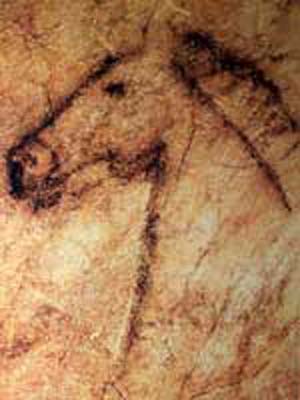
The Tito Bustillo cave complex on the Atlantic coast near Ribadesella, Spain, contains works of paleolithic art on a par with those of Altamira and Lascaux. Horses, reindeer, bison, aurochs, female figures, each drawn within its own space according to the artist's intent. For these clearly were not casual or amateur works: They are too sophisticated, and the caves are too deep and too dark. Meanings about which we can only speculate. Layers of paintings on top of one another in the largest cavern: sequential interpretations of the human world across the ages? The continual improvement of the cathedral? Commenting on previous work?

The most important material -- the human figure, sexual symbols -- is hidden away at the back of the cave, in side caverns, hard to find but indicated by discreet marks in red, painted along the passageway.

The creation of these paintings captured my imagination as I stood before them. To paint within a circle of light, when all around you is silence and darkness, except perhaps for the murmur of the subterranean river. To render not from a live model but from your imagination and memory, and to do so so accurately. To not have a flat surface but rather the irregular and quasi-three-dimensional surface of a cave wall curving upward. The  dim firelight from the lamp in your hand wavering in the air, unsteady, flickering, making the image move even as it is created.

Red dots and outlines of hands dating back 40,800 years are records of the human (neanderthal?) instinct toward pictorial creation. These are possibly the beginnings of recorded communication. But the animals in Tito Bustillo signify much more, being truly artistic renditions. A male and female deer face each other, intertwined. A curve in the rock face is used to emphasize a neck or a haunch. Using color: black, red, white, even purple. Painting images on top of images, not obliterating but enhancing, interpreting. Leaving pentimenti.

My reaction is not so much awe as confirmation. The instinct to communicate through painting. The fascination with the materials and means at hand. The desire to improve, either one's own work or that which has come before. The joy of a curve. The creativity of a dot. Realism, impressionism, minimalism, abstraction, all present so long ago.

Friday, September 13, 2013

the matter of time

Jerome and I are in Bilbao, on vacation prior to my residency in Catalonia. At the Guggenheim museum here, I was captivated by the Richard Serra installation "The matter of time". It consists of eight elliptical pieces of torqued steel that each must be at least twenty feet tall. I had seen a film about its creation; to walk through it in person was an extraordinary experience. The photo at left shows one of the eight pieces, with a second in the background. It scarcely does the work justice, but may give a sense of its form and color.

The museum displays a statement by Serra about the installation:


The torqued ellipses, spirals, spheres and toruses exist in the polarity between the downward force of gravity and their upward rise in elevation which attempts to attain a condition of weightlessness. The sculptures are not objects separated in space but on the contrary they engender the spatial continuum of their environment. They impart form to the entire space, they shape the space through axes, trajectories and passages between their solids and voids.
I titled this installation The matter of time because it is based on the idea of multiple or layered temporalities. As one experiences each work in the context of the entirety of the installation one will become aware of the obvious diversity of durations of time. The meaning of the installation will be activated and animated by the rhythm of the viewer's movement. Meaning only occurs through continuous movement, through anticipation, observation and recollection. However, there is no prescribed view, no preferred sequence, no preferred succession of views. Each person will map the space differently. There is an unlimited range of personal experiences, but they all take place over time. When I talk about time, I do not mean "real" time, clock time. The perceptual or aesthetic, emotional or psychological time of the sculptural experience is quite different from "real" time. It is non-narrative, discontinuous, fragmented, de-centred, disorienting."

I read this as true, but to me it does not express adequately the experience of walking around and through the different works. I was very aware of the moment in time as I paced through them, yet there were other more salient, and perhaps more subjective, reactions that stay with me even now, hours later. The primary memory is that, for all their grandeur and monumentality, there was a curious sense of intimacy within and around the pieces. The sensuality of the curves and of the textures of the rusted steel seemed to embrace me in a very physical way. The installation invited slow and mindful movement, and there were moments when the particular shape of space, be it an opening, a passageway, or the end of a path at the middle of a piece, invited pause. The light on the surfaces shifted, and was sometimes matte sometimes lustrous, sometimes warmer sometimes cooler, sometimes lighter sometimes darker. The changes led one onward, to see what would happen next. In fact, curiosity is a major factor in experiencing the whole installation.

I wondered what it would be like to experience The matter of time in the open air rather than inside a building, and what effect weather and time would have on it. I decided that it would be a very difference experience to explore it outside with only natural light, and that while it would be interesting, there was something about it being inside that was part of its definition. Perhaps the ceiling and walls added to the sense of intimacy that was so strong for me. In fact, experiencing it outside could detract from much of its fascination. I wonder if this was part of Serra's reason for deliberately putting it inside.

All in all, this was an interaction with a work of art that was profound and, I think, lasting. It was such a physical experience, in addition to the psychological one. I wonder if a painting could achieve a similar effect.